Hybrid Human-AI Workflows: Balancing Technology and Creativity
In our daily operations, we frequently encounter clients who stand at a complex crossroads of innovation and hesitation. They recognise the undeniable power of generative tools yet they harbour a deep-seated concern that over-reliance on technology might erode the authentic human touch that defines their brand.
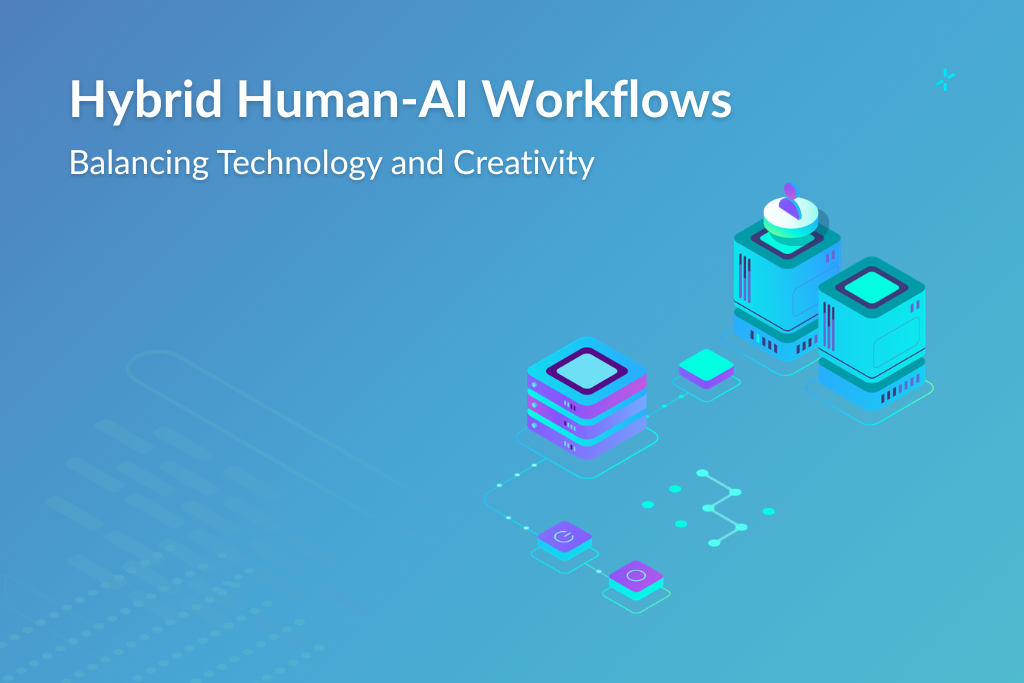
This tension is not merely a theoretical debate but a practical challenge that we navigate in every web design or video project we undertake. The goal is never to replace the artist with an algorithm but to construct a hybrid workflow where artificial intelligence acts as a sophisticated force multiplier for human intuition and strategic vision.
The Collaborative Architecture of Modern Creativity
Breaking the Barrier of the Blank Canvas
One of the most immediate benefits we see in a hybrid workflow is the elimination of the “cold start” problem that plagues many creative professionals. By utilising AI as a brainstorming partner we can rapidly generate mood boards and conceptual frameworks that previously took days of manual research. This initial phase allows our team to explore a vast array of aesthetic directions without committing significant resources to each one. According to research by IBM the combination of human creativity and AI’s capacity for rapid iteration significantly reduces the time from concept to implementation because it allows creators to brainstorm and test new concepts at an unprecedented pace. This does not diminish the designer’s role; rather it elevates it to that of a curator who selects the most resonant sparks of an idea and refines them into a cohesive brand narrative.
Scaling Production Without Sacrificing Soul
The demand for high-volume content in the digital age often forces brands to choose between quantity and quality. Hybrid workflows resolve this by automating the repeatable and technical aspects of production such as resizing assets for various platforms or performing basic colour grading in video edits. Data from IDC suggests that AI tools can save workers over 40% of their typical workday by handling routine tasks and allowing employees to focus more on designing solutions and making complex decisions. At our agency we use these efficiencies to dedicate more time to the nuanced storytelling and emotional resonance that a machine cannot yet replicate. By offloading the mechanical “grunt work” to intelligent systems we ensure that the final output maintains a high level of craftsmanship and intentionality.
Addressing the Dilemma of Digital Authenticity
Maintaining the Human-in-the-Loop Standard
A frequent question from our partners is how to ensure that AI-generated elements do not feel “uncanny” or detached from the brand’s true voice. The answer lies in a strict “human-in-the-loop” philosophy where every piece of synthetic content is vetted and modified by a professional. This oversight is becoming a market necessity as Gartner predicts that by the end of 2026 around 50% of global organisations will require “AI-free” skills assessments to combat the atrophy of critical thinking. We believe that the value of human judgement only increases as AI content becomes more prevalent. Our role is to provide that layer of ethical reasoning and moral judgement that ensures brand integrity remains intact while benefiting from the speed of technological tools.
Bridging the Personalisation Paradox
Consumers today expect experiences that are both highly personalised and deeply human. Adobe’s 2026 Creative Trends report highlights that while 80% of organisations are chasing real-time personalisation at least 60% are struggling to ensure these experiences remain brand-aligned and human. At our agency we approach this by using AI to analyse audience data and segment personas while our creative team develops the actual emotional hooks and visual metaphors. This ensures that a campaign feels like a conversation with a person rather than a sequence of automated triggers. The technology provides the “who” and “when” while the human provides the “why” and “how”.
Future-Proofing the Creative Professional
The Evolution of New-Age Skills
The shift towards hybrid work is fundamentally altering the skill sets required in the marketing and media sectors. We no longer look for purely technical proficiency in a single software but for “AI literacy” which includes prompt design and the ability to interpret and override AI outputs. By the end of 2026 it is expected that 70% of new positions in Europe will be directly influenced by AI and will require a blend of technical fluency with human-centred capabilities like empathy and domain expertise. In our agency, we foster an environment where team members act as “conductors” of technology. This transition from being a sole creator to a director of multiple intelligent tools is what defines the modern creative professional and ensures they remain indispensable in an automated world.
Navigating the Ethical Landscape of Synthetic Media
As we integrate more advanced tools into our projects we must also address the complexities of intellectual property and transparency. The generative AI market in creative industries is expected to grow from $4.06 billion in 2025 to $5.38 billion in 2026 which reflects a massive influx of synthetic assets into the global marketplace. This growth brings a responsibility to use data ethically and to be transparent with clients about when and how AI is utilised. We treat these tools with the same rigour as any other professional resource ensuring that all outputs are unique and respect the copyright standards of the industry. This proactive stance on ethics allows us to build trust with clients who are understandably wary of the legal grey areas surrounding new technologies.
Thanks for reading!
This article is part of our Marketing Knowledge series, where we share practical insights from our daily work in web design, branding and digital content. If you’d like to explore related topics, see all articles in our Marketing Knowledge section.
Frequently Asked Questions: Hybrid Creative Workflows
What exactly defines a "hybrid" human-AI workflow?
A hybrid workflow is a collaborative system where artificial intelligence handles data-heavy or repetitive tasks while humans focus on strategy, emotional depth and final creative direction. Instead of a linear process where a human does everything from scratch, the workflow becomes a cyclical exchange. For example, a designer might use generative tools to visualise five different layout concepts in minutes then manually refine the most promising one to ensure it meets the client's specific brand guidelines. This approach treats technology as a highly capable assistant rather than a replacement for the lead creator.
Does using AI mean my project will look like everyone else's?
This is a common concern among brand owners who fear the "homogenised" look of many AI-generated assets. However, the risk of generic output only exists when the human element is absent. In a professional hybrid workflow, AI is merely the starting point. The "authentic touch" comes from the human professional who applies unique brand voice, cultural nuances and specific industry knowledge to the output. By the time a project is delivered, the synthetic elements have been filtered through so many layers of human critique and modification that they are entirely bespoke to the client.
How does this approach benefit the timeline and budget of a project?
The primary advantage is the redistribution of time. By automating the mechanical aspects of production, such as technical file preparation or initial brainstorming, we can dedicate a larger portion of the project hours to high-value activities like storytelling and user experience strategy.
About Black Cliff Media
We’re a UK-based creative agency specialising in video production, website design and development, branding and visual content. Every article we publish is reviewed by our team to make sure it reflects our real project experience, so it is not just theory.
If you’d like to see how we apply these ideas in real client work, check out our latest projects.