
From Spec Sheets to Storytelling: How to Market Highly Technical Products?
We welcome Guy Boucher, EMEA Marketing Manager at Castrol, Data Centre and Thermal Management. We dive into how to embrace storytelling to market highly technical products, and how Castrol’s pivot towards fluid cooling for data centres has been a fine balancing act; marketing legacy products alongside new, ground-breaking solutions.
Most of us know Castrol for what goes into a car engine. Now the brand is applying more than a century of fluid expertise to one of the hottest problems in tech: keeping AI and high-performance data centres cool. For Guy, that has meant a fine balancing act, marketing established products alongside new, ground-breaking solutions, to an audience that wants proof as much as a story.
Thanks for joining us Guy.
1. How has being relatively non-technical helped you communicate complex ideas?
I think it’s actually been an advantage for me.
If I don’t understand something immediately, there’s a good chance parts of our audience won’t either. It forces me to ask simple questions, get to the heart of why something matters, and then translate the technical detail into something people can understand.
2. How do you balance technical information with storytelling?
I think the technical detail gives you credibility, but the story gives people a reason to care. I find that starting with the customer problem or challenge, explaining why it matters, and then bringing in the technical proof to support the story rather than leading with a list of specifications is the best approach.
3. How do you make data centre cooling products exciting and relevant?
For me, it’s about connecting the technology to what’s happening in the industry.
AI and high-performance computing are creating new cooling challenges, so rather than just talking about fluids or hardware, we talk about the role they can play in enabling the next generation of data centres. That gives the technology much more relevance.
4. How do you collaborate with engineers without getting lost in jargon?
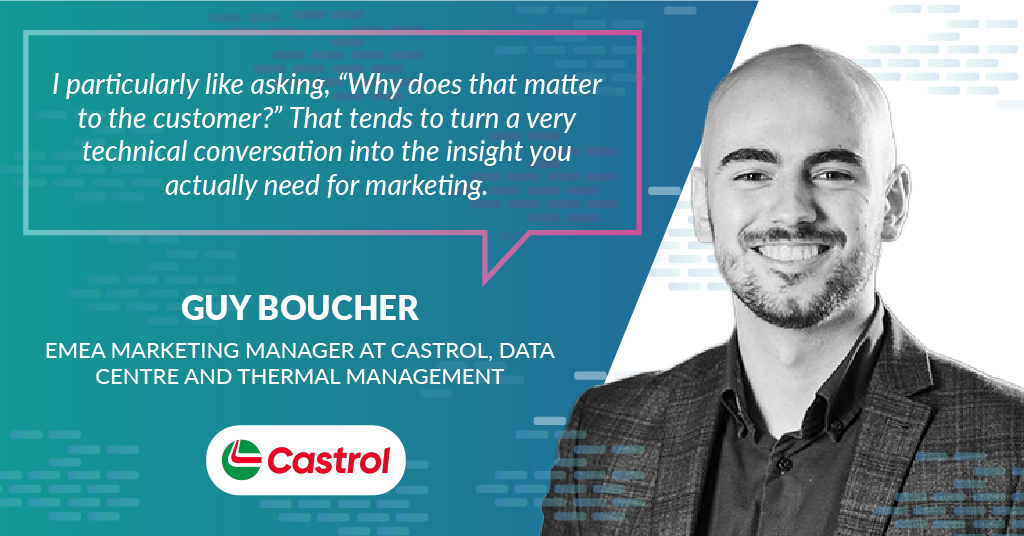
I ask a lot of basic questions and I’m not afraid to say when I don’t understand something. I particularly like asking, “Why does that matter to the customer?” That tends to turn a very technical conversation into the insight you actually need for marketing.
5. Which content formats work best with technical buyers?
I don’t think there’s one format that does everything.
Short-form content and video are great for generating interest, while case studies, technical articles and whitepapers can provide the depth and proof people need as they move through the buying process. In B2B marketing, ultimately accuracy and relevance matter more than the format itself. If the content gives people the information they need and communicates it clearly, the format becomes secondary.
6. How do you measure whether storytelling is working?
You still need the traditional metrics, but I’d look beyond clicks and impressions.
Are people spending time with the content? Are the right companies engaging? Is it generating conversations, leads or opportunities? Ultimately, good storytelling should move people from awareness through to genuine consideration.
7. What’s your next big marketing challenge at Castrol CORE?
The next challenge is taking Castrol CORE from launch to an established proposition in the market.
We need people to understand that it’s about much more than cooling fluids. It brings together technology, design, testing and lifecycle support. The marketing challenge is to make that simple and compelling, while continually building the proof and credibility behind it.
Many thanks Guy. It’s a great reminder that even the most technical products need a human story, and that “why does that matter to the customer?” might be the most useful question a marketer can ask. We wish you and the team every success with Castrol CORE.
Find out more about Castrol’s data centre cooling solutions and connect with Guy on LinkedIn to continue the conversation.